- Product
- Hump head cichlid 2"

Hump Head Cichlid 2"
Couldn't load pickup availability
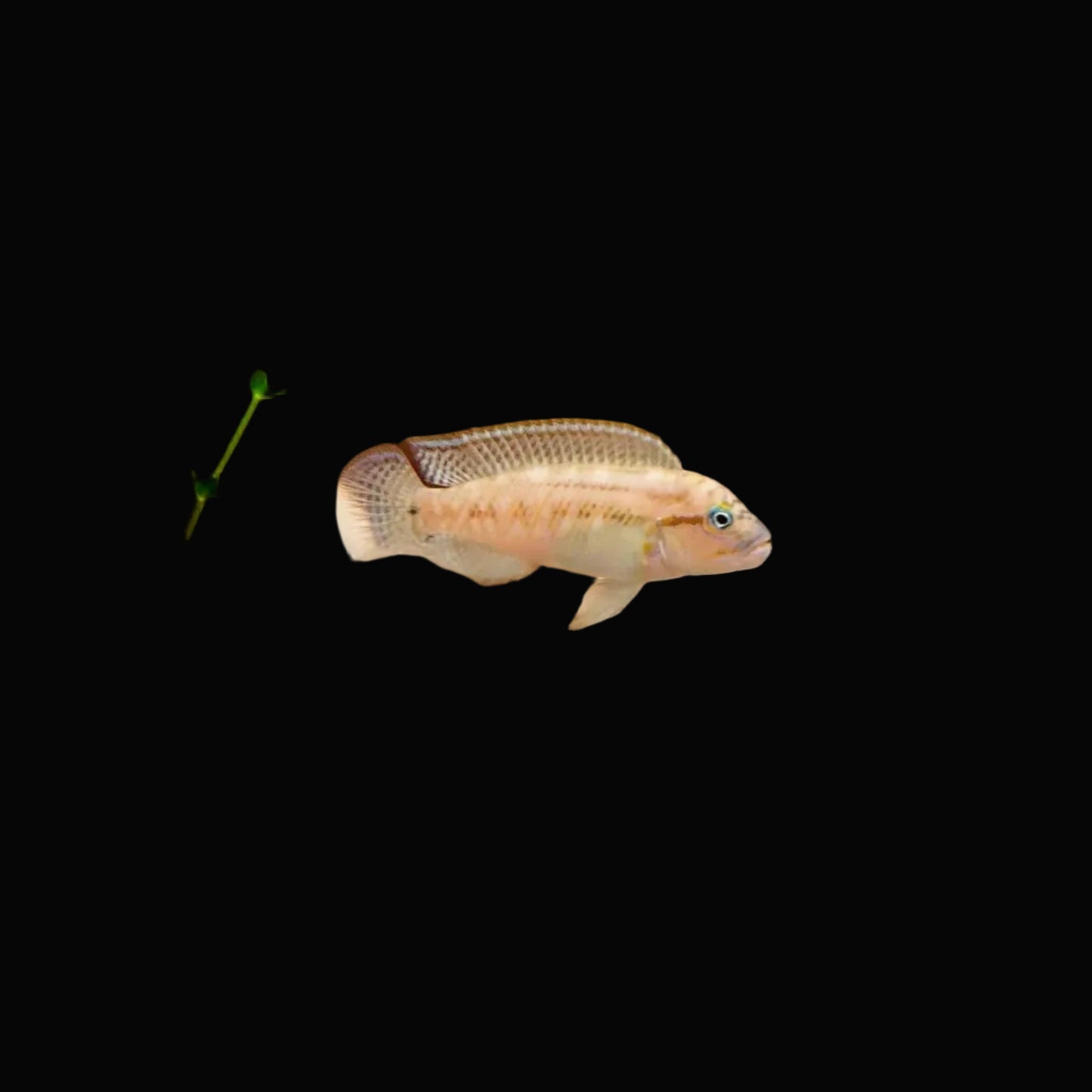
Small cichlid, big forehead, bigger opinions. Mature male Telmatochromis temporalis grow a pronounced bulge above the eyes that gives the species its shop name. Add a sturdy, muscular body, a sharp eye for anything entering its cave and a habit of shifting sand by the mouthful, and you have a lot of character packed into a fish that rarely tops 12 cm.
This is the large, rock-dwelling form of the species — not the dwarf form that lives in empty snail shells. It holds a territory among stones along the shore of Lake Tanganyika, raising its family in a cave that both parents defend. The colouring is understated brown-olive with fine pale edging to the fins, but behaviour is the selling point: digging, guarding, pair-bonding and parenting in full view in a well-built rock tank.
Give each pair its own cave and its own patch of floor.
Temporalis are tolerant of fish that respect their space and relentless with those that do not. In a 120 cm tank with a clear rock territory at one end, a pair is an easy, absorbing fish. Squeeze two pairs, or other cave-spawners, into the same rockwork and the fighting never stops.
Care Snapshot
| Scientific name | Telmatochromis temporalis |
| Also known as | Hump Head Cichlid, Temporalis |
| Family | Cichlidae — Lake Tanganyika Lamprologini (cave-spawning cichlids) |
| Origin | Lake Tanganyika — rocky shoreline habitats around the lake; this stock is captive-raised for sale (large rock-dwelling form) |
| Adult size | Males 10–12 cm; females 7–9 cm |
| Arrival size | about 2 inch |
| Lifespan | 8–10 years |
| Minimum tank | 120 litres for a pair, minimum 90 cm length; 120 cm in a mixed Tanganyikan tank |
| Temperature | 24–27 °C |
| pH | 7.8–9.0 |
| Hardness | 10–20 dGH — hard and alkaline |
| Diet | Omnivore — grazes rock film and picks off small invertebrates |
| Temperament | Territorial cave-spawner; firm but not murderous with respectful tank mates |
| Care level | Easy to moderate — hardy once its territory is sorted |
| Swimming zone | Bottom, in and around the rockwork |
Setting Up For It
- Rock caves on a sand floor. Build a stable rock pile with several narrow-entrance caves at floor level. The pair will choose one, excavate under it and treat the surrounding rock as theirs.
- Fine sand, expect digging. They move a surprising amount of sand. Rest every stone on the base glass so excavation cannot undermine it.
- Define the territory with layout. In a community tank, keep their rockwork separate from that of other cave-dwellers, with an open sand gap in between.
- Good filtration, moderate flow. Clean, well-oxygenated water with a weekly change of 20–25%. They are robust but still Tanganyikan: steady, hard, alkaline conditions.
- Lighting is flexible. Moderate light over the rock lets a little algae grow for grazing; the fish do not need a bright tank to show well.
Tank Mates
Good matches
Fish that use a different part of the tank: Cyprichromis or Paracyprichromis in open water, Julidochromis in a separate rock pile in a larger tank, Synodontis petricola, and medium-sized calm Tanganyikans such as Altolamprologus calvus in a big setup.
Keep away from
Other small cave-spawners crammed into the same rockwork, shell dwellers (temporalis will take over their area), Frontosa large enough to eat it, and boisterous mbuna. Shrimp and small community fish are simply prey or targets.
The large rock form and the dwarf shell-living form are traded under the same name. Keep stock from one source together and do not breed them with each other.
Feeding — Something Green, Something Meaty
In the wild, temporalis scrape the algae film from rocks and pick small invertebrates out of it, so the diet sits between a grazer and a micropredator. They are not fussy and not prone to bloat in the way Tropheus are, but a balance of plant and animal food keeps them in the best condition.
Feed once or twice a day, only as much as is gone in a couple of minutes. From the AQA range, a small sinking cichlid pellet works well as the staple, alternated with a spirulina-based flake or pellet, plus frozen foods two or three times a week.
Foods they take eagerly: small sinking cichlid pellets, spirulina flake, frozen mysis, brine shrimp, cyclops and chopped krill.
Sexing & Breeding
Males are noticeably larger and, as they mature, develop the forehead hump that gives the species its name. Females stay smaller with a smooth head profile. At 2 inch the difference is only starting to appear, and fish this size cannot be sexed reliably.
A cave-spawning substrate brooder. The pair excavates beneath a stone, the female lays her eggs on the cave roof, and both parents guard eggs and free-swimming fry, often for several weeks. Broods are modest by cichlid standards. Fry take baby brine shrimp and finely crushed flake, and can usually be left with the parents until the next spawn approaches.
Keeping It In Indian Conditions
- Hard borewell water fits well. Most Bengaluru borewell water is hard and alkaline already. Where the supply is softer, a crushed coral or aragonite substrate helps hold the pH up.
- Keep summer temperatures in check. Above 28 °C, add an air stone and run a fan over the surface. Brooding pairs stay calmer in a cooler, well-oxygenated tank.
- Back up the aeration. A battery air pump keeps oxygen up through power cuts, which matters most when a pair is guarding fry.
- Winter heater, set to 25 °C. Bengaluru nights can take an unheated tank below the comfortable range.
What You Receive
Captive-raised juveniles of the large, rock-dwelling form, supplied at about 2 inch, quarantined and conditioned at our Bengaluru facility before dispatch. Sex cannot be guaranteed at this size; the male's hump develops only with maturity. Colour is muted brown-olive and settles once the fish have claimed a cave. Packed with oxygen and insulation for pan-India delivery.
Covered by the Best4Pets live arrival guarantee. Please film an unboxing video before opening the bag — it is required for any DOA claim.